-
When learning how to play flag football, it’s best to start with the basics. In NFL FLAG football leagues, teams play 5 on 5 and each game consists of two halves, usually 25 minutes long. Tournament games are typically shorter with two, 10 to 15 minute halves. The clock only stops for halftime, timeouts, or injury, making games quick and competitive. Each player has a specific role on the field and every play counts.
The most important rule in flag football is that there’s no contact allowed, including tackling, diving, blocking, screening or fumbles. Instead of physically tackling an opponent to the ground, players wear flags that hang along their sides by a belt. Defenders “tackle” the ball-carrier by removing one or both of their flags.
While this rule is designed to keep players safe, there are several other rules that limit contact among players, including:
Direct hand offs, backward laterals and forward passes are all allowed.
Center sneak plays are not allowed, nor are QB runs unless it was handed off or lateraled first. The QB can run behind the line of scrimmage, but they cannot gain positive yardage.
There are no fumbles. Instead, the ball stays in possession of the offense and is spotted where the ball-carrier’s feet were when the fumble occurred.
The ball is dead when: the ball-carrier’s flag is pulled, the ball-carrier steps out of bound, a touchdown or safety is scored, the ball-carrier’s knee hits the ground, or the ball-carrier’s flag falls off.
Players can’t obstruct or guard their flags.
-
Every game starts with a coin toss (there are no kickoffs). The starting team begins on its own 5-yard line and has four downs—essentially four plays—to cross midfield for a first down.If the offense fails to advance after three attempts, they can “punt,” meaning they turn over the ball to the opposing team, which then starts from its own 5-yard line. Or they can go for a first down, but if they fail, the opposing team takes over possession from the spot of the ball.
Once midfield is crossed, the offense receives a new set of downs and has three downs to score a touchdown.
A touchdown is 6 points with the chance for a 2-point conversion with a forward pass from the 5-yard line.
A safety (2 points for the defense) occurs when the ball-carrier is declared down in their own end zone. This happens when their flag is pulled by a defensive player, their flag falls out, their knee or arm touches the ground, or if a snapped ball lands in their own end zone.
-
When players run with the ball, their feet can’t leave the ground to avoid a defensive player. In other words, players can spin to avoid their opponent, but they can’t leap or dive.
Once the ball has been handed off, all defensive players are eligible to rush and the player who takes the handoff is allowed to throw the ball from behind the line of scrimmage. So while you’ll see a designated quarterback on the field, several plays actually rely on other teammates to pass the ball. This changes up plays, keeps the defense on their toes, and makes the game even more exciting.
Also, under flag football rules, the quarterback can’t run with the ball unless it has been handed to him/her in the backfield. And all players who rush the passer must be a minimum of seven yards from the line of scrimmage when the ball is snapped.
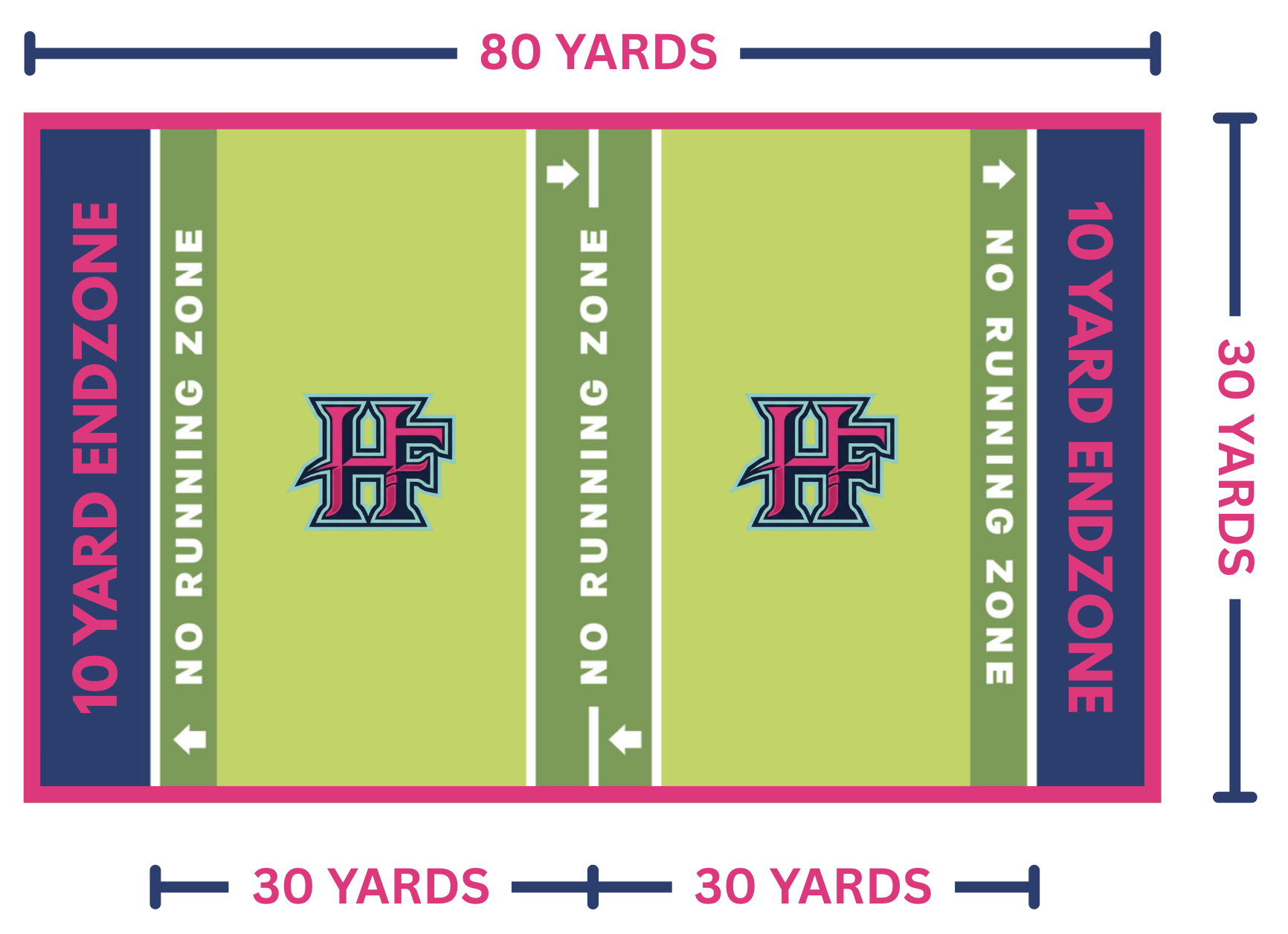
Flag football rules aim to prevent power plays and avoid short-yardage situations, so you’ll find no run zones located 5 yards from each end zone and on either side of the midfield. In this designated area, the offensive team must complete a pass play.
Lastly, if an offensive player’s flag is pulled when they’re running with the ball, their feet determine where the ball is spotted, not the flag.
-
One rule that makes flag football unique (and that much more competitive) is that everyone can receive a pass, including the quarterback, after the ball has been handed off or lateraled behind the line of scrimmage. This allows coaches to include a variety of flag football plays into their playbooks and helps players develop fundamental offense skills. Plus, it makes the game more engaging. Keep in mind that when making a catch, players must have one foot in bounds.
-
Flag football rules state that all passes must go forward and be received beyond the line of scrimmage. Shovel passes, which are short passes to forward receivers, are allowed, but also must be received beyond the line of scrimmage. Quarterbacks have a seven-second pass clock to get rid of the ball. And if they don’t, the play is dead.
Additionally, center sneak play—where the quarterback hands off to the center as the first handoff of the play—is no longer allowed.
Interceptions are allowed, but look a little different in flag football. They change the possession of the ball at the point of the interception. So if an interception occurs, the referee blows the whistle and the play is dead. Interceptions are the only change of possession that don’t start on the team’s 5-yard line.
-
Players who rush the passer must stand at least seven yards off the line of scrimmage when the ball is snapped, while players who aren’t rushing the passer may start on the line of scrimmage. The seven-yard rule no longer applies once the ball is handed off—all defenders are allowed to go behind the line of scrimmage at that point. A sack occurs when a defensive player pulls off the quarterback’s flag(s) behind the line of scrimmage. The quarterback, or anyone in possession of the ball, is down when their flag(s) are removed.
-
To set up teams for success, coaches teach a variety of formations, routes and 5 on 5 flag football plays throughout the season. And with every player being eligible to receive a pass, including the quarterback, coaches can get creative and tailor their plays to their team’s strengths—or their opponent’s weaknesses.
Some plays are complex, while others are more basic. Some go for long yardage, while others aim for short gains. In every scenario, these plays determine the flow of the game and teach players the basic fundamentals needed to succeed. In other words, it teaches them how to play flag football.
That’s why we always recommend that coaches start with the basics, helping players establish a strong foundation first, and then mix and match new and more challenging plays as their team gains confidence.
-
A flag football field is shorter than a standard tackle field at 30 yards wide and 60 yards long, with two 10-yard end zones and a midfield line-to-gain. To prevent power football in tight spaces, no run zones are located 5 yards before the end zone and on each side of the midfield line-to-gain. If the ball is spotted on or inside the no run zone, the offense must use a pass play to get a first down or touchdown.